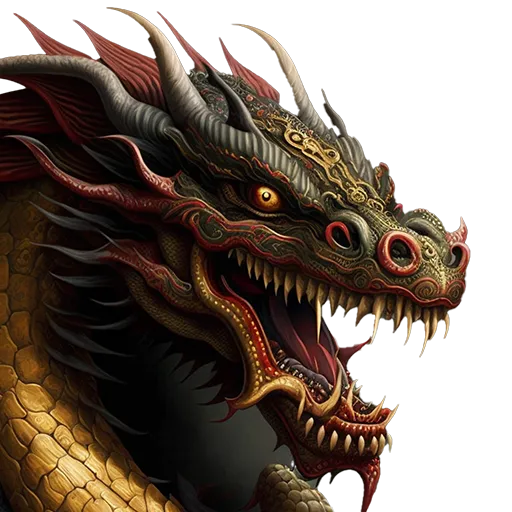
Dragons, Phoenixes, and Unicorns: Exploring Chinese Mythology
As Chinese martial arts practitioners we have all heard of dragons and phoenixes. Some Gong Fu styles are even named after these mythical creatures, for example, Long Xing Quan (龙形拳) – Dragon Shape Fist and Feng Yan Quan (鳳眼拳) – Phoenix Eye Fist. There are also many weapon forms that are named after the dragon and the phoenix.
Because I have a deep interest in Chinese culture, I am doing more research on these mythical creatures of China.
In Chinese mythology, the dragon, the phoenix, the unicorn, and the tortoise are referred to as Si Rui Shou (四瑞兽) – Four Auspicious Creatures. They embody harmony and prosperity, cosmic balance, and noble traits.
Note: The Four Auspicious Creatures should not be confused with the Si Xiang (
四象) – Four Guardians. I will write a separate post on that subject.

Long (龍) – Dragon
In Chinese lore, the Dragon originated from the imagery formed by the Bei Dou Qi Xing (北斗七星) – the Seven Starts of the Big Dipper. The Dragon is considered a benevolent creature that symbolizes power, prosperity, and good fortune. The Dragon rules over rain, rivers, and seas. It is the symbol of imperial authority; only Emperors could use the symbol of the “Five Clawed Dragons.” In Chinese philosophy, the dragon represents the male energy of Yang.

Feng Huang (鳳凰) – Phoenix
The Phoenix is considered very favorable. It is regarded as the king of birds. The male is called Feng (鳳) and the female is Huang (凰). The decorative patterns and bright plumage of the Phoenix embody benevolence, rigorousness, and trust. In China’s dynastic period, the Phoenix represented the Empress.

Qi Lin (麒麟) – Unicorn
In Chinese mythology, the male Unicorn is called Qi (麒) and the female unicorn is Lin (麟).The Unicorn is a gentle, benevolent creature and an omen of prosperity that also symbolizes longevity. During the Ming and Qing dynasties, the Qi Lin was patterned on the robes of first-rank military officials, signifying the highest rank. The ancients believed that the Unicorn only appeared during times of peace and indicated the arrival of an illustrious ruler.

Gui (龟) – Tortoise
In Chinese lore, the Tortoise represents longevity, wisdom, and stability. It is also a symbol of immortality and is associated with endurance. According to Feng Shui, people believe that keeping live turtles or turtle ornaments brings good fortune and helps ward off evil spirits.
The following are other mythical creatures popular in Chinese culture.

Qing Luan (青鸾) – Azure Phoenix
The Qing Luan is a mythical bird with blue-green plumage. It is typically mentioned together with the Phoenix as an auspicious bird. In Daoist tradition, the Qing Luan is regarded as a messenger and attendant of Xin Wang Mu (西王母) – the Queen Mother of the West.

Jiu Wei Hu (九尾狐) – Nine-Tailed Fox
In Chinese mythology the Nine-Tailed Fox is an auspicious and creature of great virtue. In later legends it is said that Nine-Tailed Fox underwent a transformation from a divine creature to a malignant spirit.

Shu Hu (孰湖)
The Shu Hu (There is no good English translation) was gentle and kind, understood human speech, and liked the company of scholars. It had the body of a horse, the wings of a bird, the tail of a snake and the face of a human. It was said to connect with the heavens.

Ji Liang (吉量) – Mythical Horse
The Ji Liang is a creature of good fortune with a white body and a red mane. Its coat does not sink in water or burn in fire, and it can travel a thousand miles in a single day. Legend has it that those who are able to ride it can live for a thousand years.

Xie Zhi (獬豸)
The Xie Zhi is a type of unicorn with a black coat. It resembles a sheep, can distinguish right from wrong, and uses its horn to attack evil. It is said to devour wicked people.
Closing Comments
There are other mythical creatures in Chinese mythology such as the Tian Ma (天馬) – Heavenly Horse, the Bi Fang (毕方) and the Bai Ze (白泽). This post is but a brief synopsis, an introduction to China’s mythical creatures. It is a starting point for those that wish to research the matter further.
The posts on this Blog reflect the knowledge I have received from my teachers, and the volumes of information I have accumulated while doing research and conducting interviews with many masters, during the years of publishing the Wu Gong Journal and the Journal of Chinese Martial Arts. All the material published on this Blog is copyrighted. — Nick Scrima