Origins and Skills of the Gong Fu Double Hooks
The Shuang Gou (雙鉤) – Double Hooks, or Twin Hooks, also known as Hu Tou Shuang Gou (虎頭雙鉤) – Tiger Head Double Hooks, is one of the exotic traditional weapons of Chinese martial arts
The hook sword is said to have originated from the ancient Ge (戈) or Dagger-Axe Halberd, which was a large-scale military weapon used for hooking and chopping. The Dagger-Axe later evolved into the Ji (戟), another type of long-handled halberd.

Archaeological finds place the origins of the Ge in the Shang Dynasty (1766-1123 BC). The Ge was used largely in chariot warfare during the Zhou Dynasty (1046-256 BC). By the late Spring and Autumn Period (770-404 BC) the weapon had evolved and was used by both infantry and cavalry. Ge-type weapons of the period were made of bronze. Some types of Ge had a hook on the opposite side of the battle-axe, which served to hook enemy riders off chariots, and also for scaling walls.
The Ji added a spearhead to the dagger-axe and was commonly used during the Han Dynasty (202-220 BC). By this time, the Dagger-Axe and Spear were made of iron and steel.

The Ji developed into various types over the centuries. Of special interest is the Qing Long Ji (青龍戟) – Green Dragon Halberd, also known as Ji Dao (戟刀) – Halberd Knife. The Qing Long Ji has a crescent-shaped blade on one side and a spearhead at the point. This weapon represented high rank and military prowess and was often wielded by generals on the battlefield. This weapon, more than other types of halberd, influenced the development of the Double Hooks, especially with regard to the handguard portion of the hook.

The Qing Long Ji can still be found within some styles of Chinese martial arts, both with a single and a double crescent blade.
Unlike the Ge and the Ji, which have a long history, the Double Hooks commonly found in many Northern Gong Fu schools, and some Southern schools such as Tsai Li Fo (蔡李佛) (Choy Li Fut in Cantonese), never developed as a large-scale military weapon. Rather, the Double Hooks were used by common martial arts practitioners, especially in North China, and it was a favorite weapon of some bodyguards who worked for the Biao Ju (鏢局) – Escort Agencies (Read the Post on Wang Wu: A Famous Martial Arts Master of the Late Qing Dynasty).
The Double Hooks can be traced back to the late Ming Dynasty (1368-1644) and gained notoriety during the Qinglong Era of the Qing Dynasty (1644-1911). Although the weapon has ancient roots, it is a relatively late arrival with respect to Chinese weapons. During the late Ming and Qing Dynasties, the Double Hooks were difficult to forge. This has changed with modern forging equipment, and they are now being massed produced.
The Shape, Length, and Parts of the Gong Fu Double Hooks
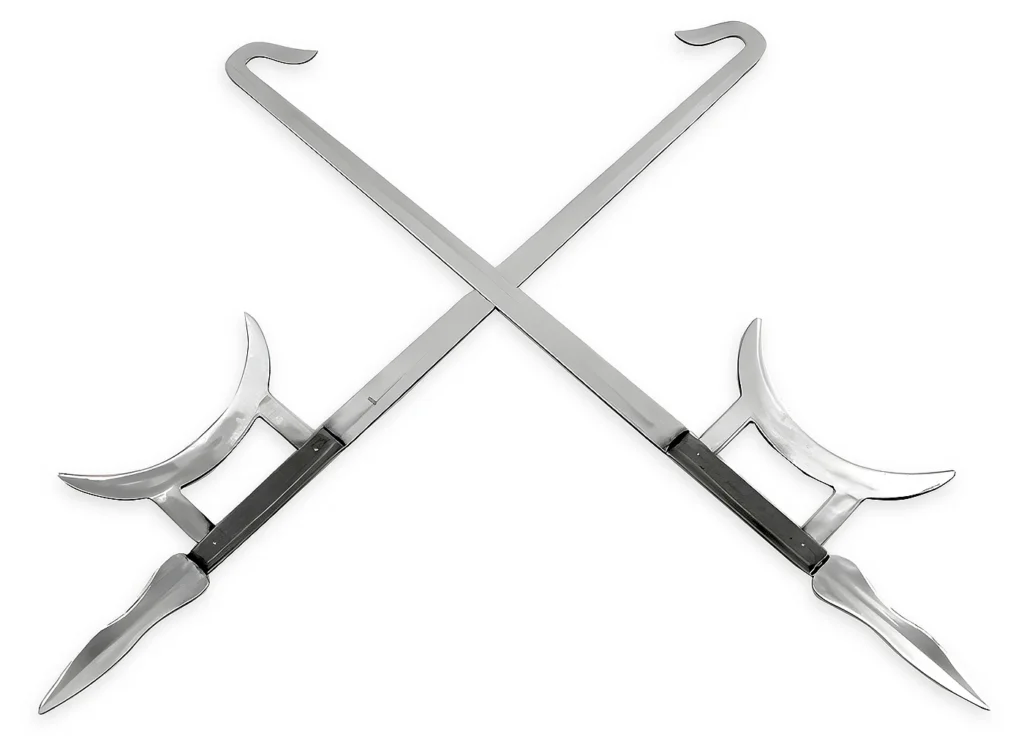
Since there are different types of hook swords, what is described here is the hook sword typically found in Gong Fu schools, and while the hook sword is commonly used in pairs, the Dan Gou, (單鉤) – Single Hook, is also found in some systems.
The handguard contains a crescent-shaped blade. The butt of the weapon contains the spearhead, the long blade is similar a two-edged straight sword, and the end tapers into a hook similar to certain types of Ge with a hook. Every part of the weapon, except the handle, is sharp. Modern practitioners, when training or performing, need to keep this in mind and should avoid shouldering the weapon as is done with the Dan Dao (單刀) – Single Saber or the Shang Dao (雙刀– Double Sabers, which are not sharp on the back side of the blade.
The length of the hook sword when held alongside the body should reach the top of the earlobe but should not be higher than the headtop.
The Double Hook consists of Eight Parts:

1. Gou Tou (鉤頭) – Hook Head, 2. Gou Kou (鉤口) – Hook Mouth, 3. Gou Ren (鉤刃) – Hook Blade, 4. Gou Ji (鉤脊) – Hook Spine, 5. Yue (鉞) – Crescent Axe, 6. Gou Bing (鉤炳) – Hook Handle, 7. Heng Geng 橫梗) – Horizontal Bars, 8. Bi Du (匕督) – Dagger Butt.
Skills of the Hook Sword
The Double Hooks are a versatile weapon that can be used at close, medium, or at long range when the two hooks are linked together. They are difficult to learn and even more difficult to master. The hooks must be wielded with extreme care since the risk of injury is considerable.
Following is a table of the major skills with the Double Hooks. The skills listed here are a compilation of skills found in Double Hooks Tao Lu Sets deriving from Mizong Luohan, Ying Zhao Fan Zi, and the Cha Quan styles that we practice at our school.
Tui (推) – Push, Dai (帶) – Carry, Tiao (挑) – Lift, Liao (撩) – Prod, Gou (鉤) – Hook, Jia (架) – Parry, Sao (掃) – Sweep, Beng (崩) – Strike, Dian (點) – Point, Bo (撥) – Clear/Push Aside, Hua (花) – Flower, Lu (縷) – Entwine, Jie (截) – Intercept, Gua (掛) – Hang, Tuo (托) – Support, Tao (掏) – Scoop, Zha (扎) – Thrust, Qie (切) – Cut, Bai (擺) – Swing, Zai (栽) – Plant, Ci (刺) – Stab, Pao (刨) – Dig.
A word about the Flowers and other techniques
Some routines with the double hooks contain certain techniques that are flashy but highly impractical, for example, some of the flowers, and the ground rolling with the double hooks. While certain flower techniques are functional in both defensive and offensive movements and as transitional movements, in the traditional routines they are used sparingly.
in the future I plan to write a post describing the various skills with the Double Hooks.
The posts on this Blog reflect the knowledge I have received from my teachers, and the volumes of information I have accumulated while doing research and conducting interviews with many masters, during the years of publishing the Wu Gong Journal and the Journal of Chinese Martial Arts. All the material published on this Blog is copyrighted. — Nick Scrima